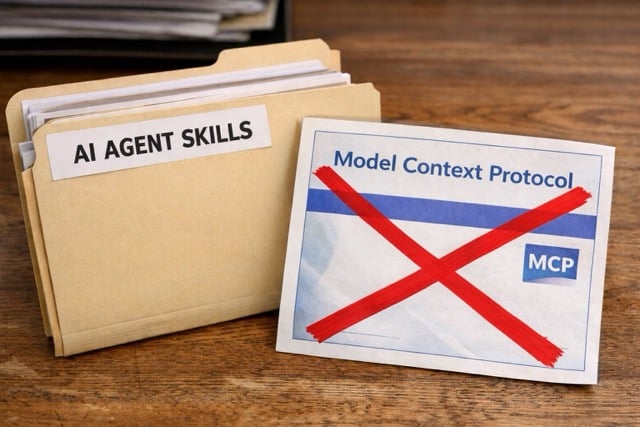
Skills vs MCP Servers: Why the Default Architecture Is Changing
For a while, MCP servers looked like the obvious future of AI tool use.
The pitch was compelling: expose tools through a standard interface, keep them available to the model, and let the agent decide what to call. In theory, that creates a clean, extensible architecture.
In practice, it often creates a context problem.
Many MCP server setups assume that tool definitions, schemas, and related instructions should stay available in the model’s context at all times. That works in some environments, but in many real-world agent systems it is inefficient. You end up paying a constant context cost for capabilities that are only used occasionally.
That is where skills are changing the design pattern.
Skills let you keep capability definitions lightweight by default and load deeper logic only when needed. In many cases, that makes them a better packaging unit than an always-present MCP interface.
So no, skills did not literally kill MCP servers. But they did weaken the case for keeping every tool surface mounted all the time.
What Is the Problem With Always-On MCP Servers?
The core issue is not MCP itself. The issue is always-on availability inside the active prompt or working context.
When a model has to carry a large tool surface at all times, several problems show up:
- More tokens are spent on tool descriptions instead of the actual task
- The model has more options to evaluate, even when most are irrelevant
- Tool selection gets noisier
- Prompt focus degrades
- Context windows get consumed by infrastructure instead of reasoning
This becomes especially noticeable when one MCP server exposes many functions, resources, or conventions but only a small subset is relevant in any given interaction.
That is bad context economics.
If a capability is only needed in 5% of cases, keeping its full interface always present is usually the wrong default.
Why Skills Are Often Better Than Full MCP Context
A skill is a lighter abstraction at the point where it matters most: the default context.
Instead of loading a full server interface up front, a skill can contain:
- a compact description of what it does
- metadata about when it should be used
- a script, workflow, or invocation template
- optional MCP instructions or server-specific context
- logic for loading deeper resources only when activated
That means the model only carries the small routing layer most of the time. The heavier instructions, schemas, or tool surfaces only appear when the system decides they are relevant.
For many AI agent workflows, that is the better tradeoff.
You usually do not need a full CRM tool interface loaded during a generic planning conversation. You do not need a data migration tool mounted in context during brainstorming. You do not need invoice reconciliation capabilities sitting inside the active prompt unless the task clearly points there.
In those cases, skills are simply the cleaner abstraction.
MCP Servers Solved a Real Problem
It would be a mistake to overcorrect and pretend MCP servers were a bad idea.
They solved important problems:
- standardized tool access
- cleaner external system integration
- a structured interface for agents to interact with capabilities
- a better alternative to ad hoc wrappers and prompt hacks
Those benefits still matter.
But many teams blurred two separate concerns: tool connectivity and prompt residency.
MCP is a transport and interface pattern. It does not automatically follow that every exposed capability should remain permanently loaded in the model’s context.
That distinction is where skills start to win.
A skill can sit above the tooling layer and act as a compact trigger. The MCP server can still exist underneath, but it no longer has to live in the model’s face all the time.
How Skills Reduce Context Bloat in AI Agents
The strongest case for skills is simple: they let you compress the long tail of rarely used capabilities.
Most agent systems do not use all tools evenly. A few tools are used constantly. Many others are situational.
That means the right architecture is not “keep everything equally available.” It is closer to:
- Keep the default context lean
- Expose a registry of lightweight skills
- Activate the right skill when the task warrants it
- Load deeper MCP-backed instructions only on demand
This design reduces context bloat while preserving access to powerful external systems.
That is why skills feel increasingly like the right default for production agents.
Why On-Demand Skill Loading Works Better
There are three practical reasons this model tends to perform better.
1\. Most tool usage is sparse
Many agent tools are episodic, not continuous. They matter only for specific task patterns. Loading them only when needed is more efficient than treating them as always-active prompt residents.
2\. Skill routing is improving
Agent frameworks are getting better at deciding which capability to use. Some use planners, classifiers, retrieval layers, or compact registries. Others rely on model-driven routing over small metadata summaries.
As routing improves, the need for always-loaded tool context gets weaker.
3\. Smaller active context usually produces cleaner behavior
Less irrelevant prompt material usually means better focus. The model sees fewer distracting options, the relevant instructions are more legible, and tool calls become more intentional.
That often leads to:
- fewer unnecessary tool invocations
- better skill selection
- better workflow adherence
- more usable room in context for actual reasoning
Skills vs MCP Servers: A Better Mental Model
A useful way to think about this is:
- MCP servers are infrastructure
- Skills are activation interfaces
The MCP server gives the system capability. The skill determines when that capability should become active.
That distinction matters.
Many teams originally treated direct tool exposure as both the plumbing and the UX layer for the model. But those are different design problems. Backend connectivity should not automatically dictate what sits in the prompt at all times.
Skills separate those layers more cleanly.
When MCP Servers Still Make Sense
There are still real cases where direct MCP exposure remains the right choice.
For example:
- IDE-style environments with constant file, diff, and code operations
- highly interactive systems where many tools are used repeatedly
- environments where dynamic discovery matters
- workflows where chaining across tools is continuous rather than occasional
- systems where on-demand loading would introduce more friction than value
In those cases, keeping tools closer to the model may still be worth the context cost.
But that set of use cases is narrower than people first assumed.
A lot of early agent systems adopted the maximal pattern by default. That made sense when the ecosystem was still exploring tool standards. It makes less sense once you recognize how much waste comes from permanently loading rarely used capabilities.
Are Skills Replacing MCP Servers?
Not exactly.
Skills are not replacing MCP servers so much as reframing their role.
Instead of being the thing the model constantly stares at, MCP increasingly becomes the implementation layer behind a smarter routing system. The skill becomes the lighter-weight abstraction the model sees first.
That is the real shift.
The architecture is moving away from “everything mounted all the time” and toward “load the right capability at the right moment.”
The Future of AI Agent Tooling Is Probably Layered
The most practical architecture for many agent systems now looks something like this:
- a lean default prompt
- a lightweight skill registry
- a routing layer that decides what to activate
- deeper tool or MCP-backed capability loaded on demand
That structure is usually easier to reason about, cheaper in context, and often more robust in practice.
It also matches how real work happens. Most tasks do not require every tool at once. They require the right tool when the problem becomes specific enough.
Conclusion: Skills Didn’t Kill MCP Servers, But They Did Change the Default
Skills did not make MCP obsolete.
What they did do is expose a design mistake: many systems were treating full tool availability as the default, even when the task pattern did not justify it.
For a large class of AI agent applications, skills are the better packaging unit. They reduce context overhead, improve focus, and let you defer heavy tool instructions until they are actually relevant.
MCP servers still matter. But in many systems, they increasingly look like plumbing rather than the main abstraction.
That is why the title is only half joking.
Skills killed MCP servers, kind of.
FAQ
What is the difference between a skill and an MCP server?
An MCP server exposes capabilities through a structured interface. A skill is a lighter activation layer that tells the system when and how to use a capability, often loading deeper MCP context only when needed.
Why are always-on MCP servers a problem?
They can consume too much context, introduce noise, and make tool selection less efficient when many capabilities are only used occasionally.
Are MCP servers still useful?
Yes. They are still useful for highly interactive or tool-dense environments where many capabilities are used continuously.
Why are skills becoming more important?
Because they let agent systems keep default context lean while still accessing powerful tools on demand. As routing improves, this becomes a stronger default pattern.