Video Killed The Radio Star
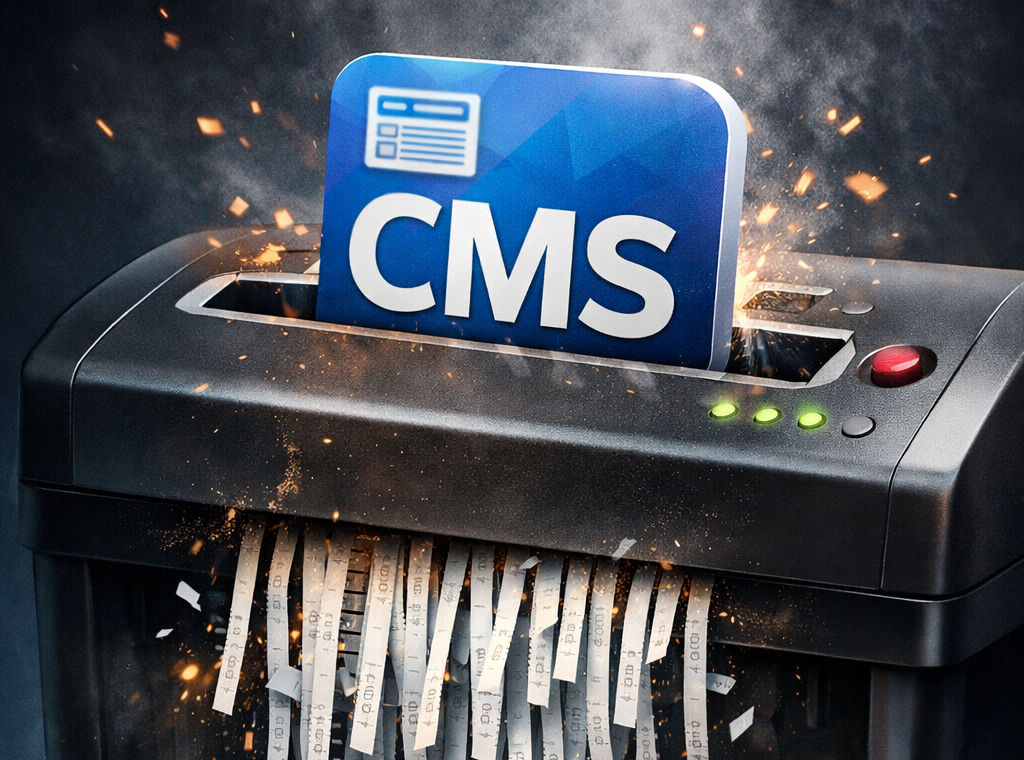
For years, the CMS was treated as essential web infrastructure.
If a business wanted to update website copy, publish blog posts, manage landing pages, or give non-developers control over content, the default answer was usually the same: use a content management system. That led to massive adoption of platforms like WordPress, Drupal, and Contentful.
But AI is changing the assumptions that made CMS platforms so valuable in the first place.
The old reason for using a CMS was simple: most people could not safely edit a website in code. Now they increasingly can, through AI agents. And once that happens, much of the CMS starts to look less like infrastructure and more like overhead.
What is a CMS?
A CMS, or content management system, is software that allows people to create, edit, organize, and publish website content without directly modifying the site’s codebase.
Common examples include WordPress, Drupal, and Contentful. Some CMS platforms are traditional all-in-one systems. Others are headless and API-driven. That architectural difference matters in implementation, but not much in the broader argument here.
At a high level, all CMS platforms exist to solve the same problem: separating content editing from the code that renders the website.
That used to be extremely useful. Now, in many cases, it is just another layer to maintain.
AI is replacing the “change the copy” use case
A large percentage of CMS usage comes down to one basic job: changing content.
A team wants to update a homepage headline, revise product page copy, swap a CTA, edit metadata, publish a case study, or tweak an about page without asking a developer to make the change manually. Historically, that is exactly what a CMS was for. But AI agents are now capable of handling this workflow directly.
A marketer or founder can tell an AI system:
- “Rewrite the hero section to focus on speed and implementation clarity.”
Or:
- “Update the pricing page to sound more premium and reduce vague agency language.”
The AI can make the change in the actual codebase, often with enough context to preserve tone, layout, and structure.
That is the real disruption.
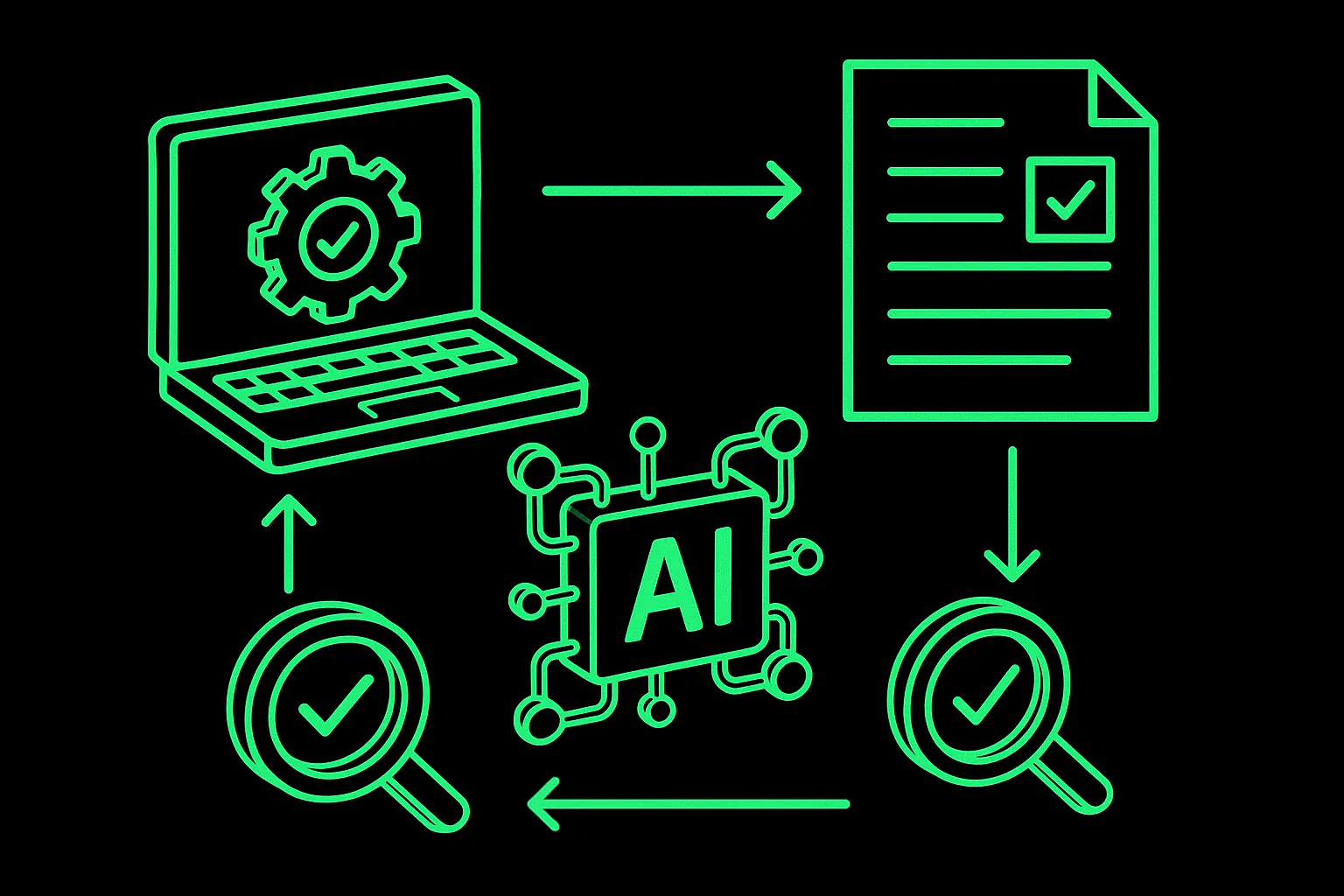
The CMS was not just a content tool. It was an access tool. It existed because non-programmers needed a safe interface for editing sites. AI is quickly becoming that interface. Once non-technical users can direct changes through AI instead of through a CMS dashboard, a lot of CMS-related complexity stops making sense.
Website content no longer needs a CMS to be editable
The strongest historical argument for a CMS was that code was inaccessible. That argument weakens significantly once AI can operate as an intermediary between the user and the codebase.
Instead of training team members on a CMS, configuring fields, maintaining integrations, and dealing with preview limitations, many teams can now work from intent:
- “Add a testimonial section under the hero.”
- “Change the homepage language to target B2B SaaS founders.”
- “Update all service pages to align with the new positioning.”
That does not eliminate the need for review. It does eliminate much of the need for a CMS to serve as the editing surface.
This is the uncomfortable truth for many content platforms: AI agents are becoming better at translating business intent into site changes than CMS interfaces are.
Blog posts can live directly in the codebase
Blog publishing is another area where the CMS is losing its advantage. Many companies still use a CMS mostly because they have a blog. But blog content is one of the easiest things to move out of a CMS entirely.
Markdown works. MDX works. Static site generators work. Frontmatter works. Flat files in a repository work. For many modern websites, blog posts do not need a database-backed publishing platform. They just need structured content files and a build pipeline.
This approach is often faster, cheaper, easier to version, and much more AI-friendly.
An AI agent can draft a post, revise it for tone, optimize headings, add metadata, structure internal links, and save it directly as Markdown in the repo. The entire workflow becomes simpler because the content lives closer to the rendering logic.
If your CMS is mainly acting as a blog editor, that is increasingly hard to justify.
CMS platforms are often standing in for a database and admin dashboard
Not all CMS usage is just about copy or blog posts.
Many companies also use CMS platforms to manage structured objects, reusable content blocks, complex page layouts, directories, resource libraries, location pages, product-like entries, or other semi-structured business data.
In practice, the CMS often becomes a substitute for two things:
- a database
and
- an admin dashboard
That was historically a practical shortcut. Building internal tools used to require enough engineering effort that teams tolerated the awkward fit of a CMS instead.
AI changes that tradeoff.
AI is now extremely fast at generating custom admin dashboards, CRUD interfaces, validation flows, internal tooling, and business-specific management systems. What once required a dedicated internal tools effort can now be scaffolded and implemented much more quickly.
That weakens another major reason to use a CMS.
If a CMS is mostly functioning as a generic object editor with some publishing features, AI makes it much easier to replace that system with something purpose-built.
AI works better with code-first websites than CMS-powered websites
This is one of the most important points, and one many teams miss.
AI performs better when it has context.
Code-first websites give AI exactly that.
When content, components, data structures, and rendering logic are all visible inside the codebase, AI can inspect the system more holistically. It can see how content is used, how components are structured, how pages are assembled, and what effect a change is likely to have.
CMS-powered sites often split that context apart.
The content model may live in one platform. The frontend components live somewhere else. The rendering logic is detached from the editing interface. Relationships are often implicit rather than obvious. Preview environments may be partial or unreliable.
That fragmentation makes AI-assisted editing harder.
The AI may see the frontend but not the actual content driving it. Or it may see the CMS schema without enough UI context to understand what the resulting page should look like.
This is where code-first architecture wins.
When the source of truth is close to the implementation, AI can reason better, edit faster, and make more reliable changes.
If you want AI to be genuinely useful in website iteration, design changes, content updates, and structural edits, reducing architectural indirection matters.
CMS platforms often increase that indirection.
Why code-first web development fits the AI era better
Code-first websites are not automatically better in every situation. But they are often a better fit for how modern teams will actually work with AI.
A code-first setup makes it easier to:
- update content directly
- keep rendering logic and content close together
- version everything cleanly in Git
- let AI agents understand page structure
- generate or modify admin tooling as needed
- reduce vendor dependency and integration overhead
- move faster on design, content, and experimentation
The CMS was designed for a world where editing content without touching code was the main bottleneck.
Now the bottleneck is shifting.
The question is no longer, “How do we keep non-technical users out of the codebase?” It is increasingly, “How do we give AI enough context to make high-quality changes quickly?”
Those are not the same problem.
Will AI completely replace CMS platforms?
Not immediately.
Many organizations will continue using CMS platforms for years. Large teams still care about permissions, workflows, governance, localization, editorial approval chains, legal review, and the comfort of established systems. There are absolutely environments where a CMS will remain the preferred choice.
But that should not obscure the broader trend.
For smaller teams, startups, design-forward agencies, and fast-moving companies, the default assumption that every website needs a CMS is becoming much harder to defend. In many cases, the CMS is no longer solving a core problem. It is preserving an old workflow that AI has started to dissolve.
Final thoughts: AI will not kill every CMS, but it will kill the default
AI will not wipe out WordPress, Drupal, Contentful, or every other CMS overnight. But AI is attacking the reasons these platforms became standard.
- If copy can be changed by AI agents, you need less editorial overhead.
- If blog posts can live in Markdown, you need less publishing infrastructure.
- If admin dashboards can be generated quickly, you need less CMS-driven object management.
- If AI edits code-first sites more effectively, you need less architectural separation between content and implementation.
That does not mean no one will use a CMS. It means the burden of proof is shifting. In the age of AI, the real question is no longer whether you can use a CMS. It is whether the CMS is actually helping you move faster.
For a growing number of teams, it is not.